When to Clean Gutters Before a Syracuse Winter
Every fall we get the same call, and it usually comes in mid-November after the first hard freeze: "I just had my gutters done last month and they're already packed." The homeowner did nothing wrong. They cleaned their gutters when the internet told them to. The problem is that most gutter-cleaning advice is written for places that aren't Central New York.
If you live in Syracuse, Manlius, Fayetteville, Liverpool or anywhere under Onondaga County's tree canopy, the honest answer to when should I clean my gutters is not a single date. It is two passes, and the timing of the second one is what separates a system that works all winter from one that turns into a block of ice over your front door.
The short answer
For most Central New York homes, gutters need cleaning twice a year: once in spring after the seeds and buds drop, and once in late November after the trees are genuinely bare. Homes with heavy oak or maple coverage often need a third pass in early October just to keep water moving through the peak drop.
The mistake is cleaning once in early October and calling it done. In this region, that gap between the maples and the oaks is where most winter gutter failures start. At US Vets Exterior Cleaning we schedule our heaviest gutter cleaning weeks from the first week of November through the first week of December, and there is a reason for that.
Why the standard advice doesn't work here
National home-maintenance articles usually say "clean your gutters in the fall." That is fine guidance in a region where leaves come down over two or three weeks. Central New York doesn't work that way.
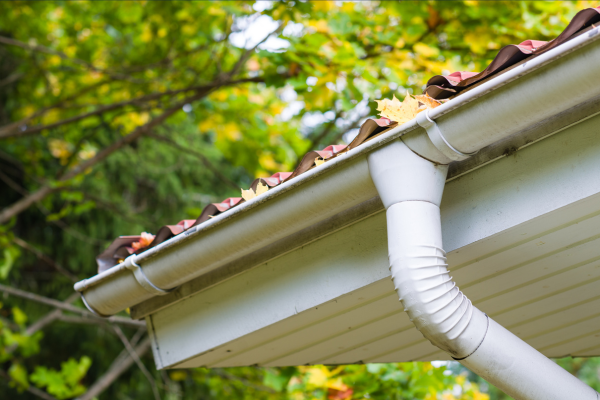
Our canopy is dominated by oak, maple, ash and locust, and those species drop on very different schedules. Maples start early and are largely finished by mid-October. Oaks hold on stubbornly — in a mild year, a mature red oak in Sedgwick or Scottholm will still be shedding into the third week of November. Some oaks keep a skirt of brown leaves right through December. Locust drops tiny leaflets that slip straight past a gutter guard and settle into a dense mat at the bottom of the trough.
So if you clean on October 5th, you have cleaned out the maples and left yourself completely exposed to the oaks. Six weeks later, the trough is full again, the downspouts are plugged, and the first freeze arrives before anyone notices.
The local rule of thumb: wait until the oaks in your yard are bare. If you can still see leaves on the tree, there are still leaves headed for your gutters. In most of Onondaga County that has meant the back half of November in the seasons we've worked here.
The Central New York gutter calendar
Early October — optional overflow pass
Only needed if your home sits under heavy maple or ash cover, or if your gutters are already visibly overflowing during a rainstorm. This pass is about keeping water moving through the peak of the drop, not about getting the system clean for winter. Think of it as maintenance, not the real cleaning.
Mid-to-late November — the one that matters
This is the critical window and the one most homeowners miss. The trees are bare, the trough can be cleared completely, and the downspouts can be flushed and checked before the temperature stops climbing above freezing. A gutter cleaned in late November will typically carry you through to spring. A gutter cleaned in early October will not.
April into May — the spring pass
People assume spring cleaning is optional because "the leaves already fell." It isn't. Maple seeds, oak tassels, buds, shingle grit and whatever blew in over the winter all accumulate fast, and spring is when Central New York gets its heaviest sustained rainfall. A clogged gutter in April dumps water directly against your foundation during the exact weeks the ground is already saturated from snowmelt. Our US Vets Exterior Cleaning crews stay busy with spring gutter cleaning from early April onward for that reason.

What actually goes wrong when you miss the November window
Ice dams
This is the expensive one. When a gutter is packed with wet leaves and then freezes, it stops being a drainage channel and becomes a dam. Meltwater running off the roof hits that blockage, backs up under the shingles, and finds its way into the roof deck, the insulation and eventually the ceiling below. Central New York's freeze-thaw cycling makes this worse than it would be in a colder, more stable climate. Syracuse drops to 32°F or below on roughly 133 days a year, but only about 47 of those days never climb back above freezing — which leaves something like 85 days a winter where the roof warms enough to melt and then refreezes overnight. Every one of those crossings drives water a little further under the shingle line.
Fascia and soffit rot
A full gutter is heavy. Wet leaves plus standing water plus ice load a run that was engineered to carry flowing water, not dead weight. That load pulls the gutter away from the fascia board, opens a gap, and lets water run directly down the back of the trough into the wood. By the time you see a soft spot or peeling paint on the fascia, the damage has usually been underway for two or three seasons.
Foundation and basement water
A downspout exists to move roof water away from the house. When it's plugged, that water instead sheets off the gutter edge and lands in a concentrated line right at the foundation. In our freeze-thaw climate that water works into hairline cracks, freezes, expands and widens them. Plenty of Syracuse basement seepage that gets blamed on the foundation actually starts as a gutter problem on the roofline — and costs a great deal more to chase at the basement end than it would have at the gutter.
Tiger stripes
Those vertical black or brown streaks down the face of white gutters are not dirt in the usual sense. They're a mix of roof runoff, oxidized aluminum and airborne grime that bonds to the finish, and pressure alone will not remove them — it will just dent your gutters. They need the right cleaning solution and the right technique, which is why our gutter cleaning service includes exterior brightening rather than treating it as an upsell afterthought.
Your neighborhood changes your schedule
Tree cover in Onondaga County varies enormously street to street, and it matters more than the age of your home.
The established neighborhoods — Sedgwick, Scottholm, Strathmore, Westcott, Eastwood, the University area — sit under genuinely mature canopy. Those homes often genuinely need three passes a year, and the November cleaning cannot be skipped. Same goes for older sections of Manlius, Fayetteville and Skaneateles where the street trees are full-grown.
Newer developments in Clay, Cicero, Baldwinsville and parts of Camillus tend to have younger, smaller trees and less overhang. Two cleanings a year is usually plenty there, and the October pass is rarely necessary.
The variable most people underestimate is a single large tree directly over one roof section. We regularly find homes where three gutter runs are nearly clean and the fourth — the one under the oak — is completely packed. That one run is all it takes to put water where it shouldn't be.
Not sure which schedule your home needs? We'll take a look and tell you straight. Call US Vets Exterior Cleaning at (315) 273-0100 for a free estimate on gutter cleaning in Syracuse and Central New York.
What a professional gutter cleaning should include
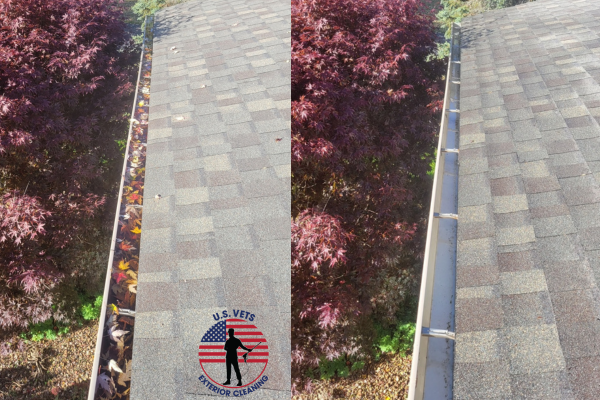
Not all gutter cleaning is the same job, and the difference shows up in February. A proper service covers:
Full hand removal of debris from every run, not just the accessible front of the house.
Downspout flushing to confirm water actually exits at the bottom. A clear trough feeding a blocked downspout is still a failed system, and this is the step most often skipped.
Debris hauled away, not blown onto your roof, your landscaping or your driveway.
A look at the hardware — loose hangers, separated seams, pitch that has shifted, gaps behind the fascia. These are cheap to catch early and expensive to catch late.
Exterior brightening to deal with tiger striping while the crew is already there.
When you book gutter cleaning with us, all of that is the job — not a menu of extras.
Should you do it yourself?
Plenty of Central New York homeowners clean their own gutters, and on a single-story ranch with a walkable roof and a stable ladder setup, that's a reasonable Saturday.
Where we'd push back is on two-story homes, steep pitches, and anything in late November. Ladder falls are overwhelmingly a homeowner problem rather than a jobsite one — a study in the American Journal of Preventive Medicine found that 97% of ladder-related injuries treated in U.S. emergency departments happened outside of work, in places like homes and farms. And the November conditions here are exactly when it goes wrong: wet leaves, frost on the rungs, early darkness, soft ground under the ladder feet. A two-story colonial in Fayetteville needs a 28-foot extension ladder set on damp lawn, and that is not a job worth the savings.
The other thing homeowners miss is what a trained crew notices on the way past. We routinely spot early algae streaking on a roof, a lifted shingle, a separated gutter seam or a soffit stain that the owner hadn't seen. Catching a roof problem in November is a different conversation than discovering it in March.
Bundle the fall work
The most efficient thing a Central New York homeowner can do is handle gutters and roof in the same visit. The crew is already set up, the roof is already accessible, and algae streaking — that black staining on north-facing shingles that our humidity and tree cover produce so reliably — is best treated before winter rather than after. Our roof cleaning uses low-pressure soft washing that kills the organism at the root instead of blasting granules off your shingles.
If you want the full seasonal picture, our fall home maintenance checklist for Central New York walks through everything worth doing before the snow, and our guide to professional gutter and roof cleaning in Syracuse covers how the two services work together. If you're outside the city, we've written specifically about gutter cleaning in Minoa as well.
Book your November cleaning now
Late November is a narrow window and it fills. Every year we have homeowners call in the second week of December wanting a cleaning before a cold snap, and by then the schedule is gone and the leaves are frozen in place.
If your gutters haven't been cleared since last winter, or you had them done back in early October and the oaks in your yard have finished dropping, US Vets Exterior Cleaning can get you on the calendar. We're veteran-owned, fully insured, New York State Certified Service-Disabled Veteran-Owned, and we back our work with a 100% satisfaction guarantee.
Call (315) 273-0100 for a free estimate
Or request a quote online for gutter cleaning in Syracuse, Manlius, Fayetteville, Liverpool, Camillus, Baldwinsville and across Onondaga County.
How often should gutters be cleaned in Syracuse, NY?
Twice a year for most homes — once in spring, once in late November. Homes under heavy oak or maple canopy in neighborhoods like Sedgwick, Strathmore or Westcott often need a third pass in early October to keep water moving through the peak leaf drop.
What is the best month to clean gutters in Central New York?
November. Specifically the stretch from around November 10th through the end of the month, once the oaks have finished dropping but before sustained freezing sets in. October cleanings leave you exposed to six more weeks of falling leaves.
Can I skip the fall cleaning if I have gutter guards?
No. Guards reduce how much debris gets in, but they don't eliminate it — fine material like locust leaflets, maple seeds, shingle grit and pine needles works straight through most systems and settles at the bottom of the trough. Guarded gutters still need annual service, and the guards themselves need clearing.
What happens if I don't clean my gutters before winter?
The most serious risk is ice damming, where a frozen blockage forces meltwater back under your shingles and into the roof deck, insulation and ceiling. Beyond that, the weight of wet debris and ice pulls gutters away from the fascia, and blocked downspouts dump roof water directly against your foundation during freeze-thaw cycling.
Is it too late to clean gutters in December?
Often, yes. Once debris has frozen into the trough it cannot be removed without risking damage to the gutter, and ladder work becomes genuinely unsafe. If you're reading this in early December, call and we'll tell you honestly whether it's still workable for your home.
How do I know if my gutters are clogged?
Watch during a hard rain. Water spilling over the front edge, a downspout that stays dry while it's pouring, or water running down the back of the gutter into the fascia are all signs of a blockage. Plant growth in the trough, staining on the siding below, and sagging sections are signs it has been going on a while.
What are the black streaks on my gutters?
Those are tiger stripes — a bonded mix of roof runoff, oxidized aluminum and airborne grime. They aren't loose dirt, so pressure washing won't remove them and may dent the gutters. They require the right cleaning solution and technique, which is included in our gutter cleaning service.
Should I clean my gutters and roof at the same time?
It's the most efficient approach. The crew is already set up and the roof is already accessible, and treating algae streaking before winter is far better than letting it feed through a wet Central New York season. Our roof cleaning uses low-pressure soft washing rather than pressure, which is what protects your shingle granules.
